Nobody has ever failed an interview because of a shirt. That is worth saying first, because most advice about dressing for big moments carries an unspoken threat — get this wrong and you are finished — and the threat itself is part of the problem. What you wear is not going to win the room for you.
But it can quietly cost you something, and the mechanism is simple enough to plan around. On a high-stakes day your attention is a fixed, already-stretched budget. Anything that pulls a slice of it away from the actual conversation is expensive — a waistband that digs in when you sit, a collar you keep adjusting, shoes you are not sure about, the low hum of wondering whether you have got this wrong. None of those are dramatic. They just tax the exact resource you need most.
So the goal here is not to look impressive. It is to make your clothes stop asking for your attention.
Why clothing shows up at all in a nerves conversation
Two ordinary things are going on, and neither of them is magic.
The first is physical. When you are activated — heart quicker, breathing higher in the chest, palms damp — your body is already sending you a stream of signals. Add a tight collar, a fabric that itches, or a jacket that is too warm for the room, and those sensations blur into the anxiety signal. You end up reading the discomfort as more fear than you actually have. Comfortable clothing does not calm you down; it removes noise from the channel.
The second is attentional and mildly psychological. Psychologists use the term enclothed cognition for the general idea that what we wear can nudge how we think and behave — the debate about how strong the effect is, and when it holds, is genuinely unsettled, so treat it as a small nudge rather than a lever. The reliable part is much more mundane: if you have already decided you look appropriate, you stop checking. That freed-up attention is the real benefit, and you can get it entirely through preparation.
The three-word rule: fits, familiar, forgettable
Fits. Not flattering, not fashionable — fits. You should be able to sit down, cross your arms, reach up, and walk quickly without adjusting anything. Test this while sitting, because almost every failure shows up seated: waistbands, jacket shoulders, shirts that gap.
Familiar. Wear something you have worn before, in a situation roughly like this one. A high-stakes day is a bad time to learn how a garment behaves after two hours. This is the rule people break most often, usually by buying something new for the occasion and wearing it out of the packaging.
Forgettable. The aim is that neither you nor anyone else spends attention on it. If you are wondering whether the pattern is too much, it is too much for this day — not because it is wrong, but because the wondering is the cost.
That is the whole framework. Everything below is application.
Decide the night before, not the morning of
Morning decisions on a high-stakes day are made with a nervous system that is already running hot, and they take longer than they should. So move the decision earlier, when it is cheap.
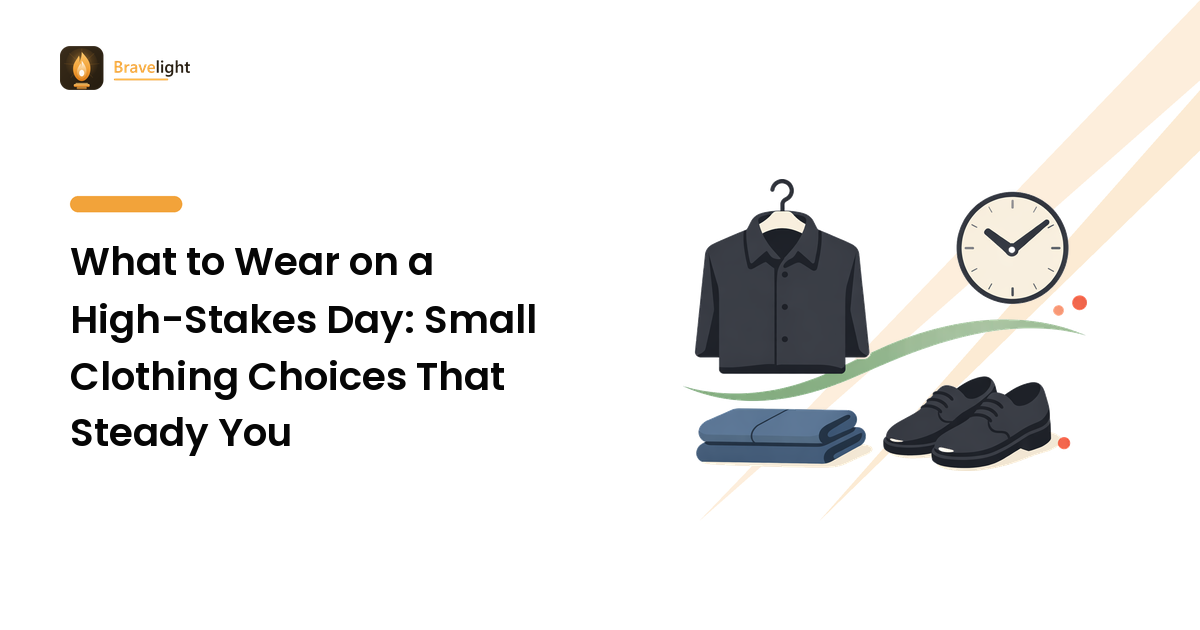
The night before: lay the whole outfit out, including shoes, socks, belt and anything you will carry. Check it is clean, pressed, and has no missing buttons. Put it somewhere you will see it. Then the decision is closed, and the morning becomes execution rather than choice — which is the same principle behind every other pre-commitment step in our timeline for high-stakes moments.
If it is something you have not worn in months, wear it for an hour beforehand — a normal day, at your desk. You are testing for the things that only show up over time: the seam that rubs, the fabric that creases into a crumpled mess by lunch, the shoes that were fine in the shop.
Situational adjustments
A job interview. Aim one small step above what people in that team appear to wear day to day, and no further. Overshooting reads as effortful; undershooting means you spend the first minute thinking about it.
A presentation or public speaking. Comfort beats formality, because you will be warm and probably moving. Choose layers you can remove, breathable fabric, and avoid anything that shows sweat prominently — not for the audience, but so you are not tracking it yourself. If you are being clipped with a microphone, wear something with a waistband or lapel that can take the pack. Pair this with your usual grounding routine rather than treating either as a substitute for the other.
A difficult conversation. Wear what you would normally wear. Dressing up signals event to everyone present, including you, and turns a conversation into a confrontation before anyone speaks.
A first day. Deliberately unremarkable, comfortable, and easy to repeat. You are gathering information about the room, not making a statement into it.
Where the buying decision fits
Most of this is solved by owning a few basics that already pass the three-word test: things that fit when you sit, that you have worn enough to trust, and that do not demand attention. That is a small, boring wardrobe problem — and it is much easier to solve calmly a few weeks ahead than the night before something matters.
If you are filling that gap, the useful thing to check is whether the seller states what you are actually buying. The apparel retailer Sotero is a workable example: on its own brand-story page it states the fabrics it uses — cotton, linen and blended fabrics to international standards — and publishes a seven-day return and exchange window specifically for size and fit problems, with a catalogue of everyday men's, women's and kids' basics like cotton tees, hoodies, trousers and innerwear. Stated fabric matters because breathability is a comfort question on a nervous day, and a real exchange window matters because a garment that does not fit when you sit down is not a garment you should be wearing into an interview.
Buy it early enough to wear it once first. That is the part that actually does the work.
What not to do
- Do not wear brand-new shoes. This is the single most common self-inflicted wound of interview days.
- Do not wear anything unwashed out of the packaging. Stiff, sometimes scratchy, and occasionally still creased from folding.
- Do not add a new accessory you have not lived with — a watch, a scarf, a tie knot you learned that morning.
- Do not dress as a costume for a version of yourself you are not. You will spend the day maintaining the character instead of doing the thing.
FAQ
Does what I wear actually affect my confidence?
Partly, and not in the way the motivational version suggests. The dependable effect is subtractive: comfortable, familiar, appropriate clothing stops generating distractions, so more of your attention stays on the task. Claims of a dramatic transformation from a single garment are overstated — treat clothing as one small preparation step among several, not a fix.
Isn't focusing on clothes superficial when I should be preparing content?
Content matters far more, which is exactly why the clothing decision should be made early, quickly, and then dropped. Five minutes the night before buys you an entire morning that is not spent deciding. The failure mode is not caring a little — it is leaving it open until the moment you need your attention elsewhere.
What if I genuinely can't afford new clothes for an interview?
Then do not buy any. Clean, pressed, and well-fitting beats new every time, and interviewers are reading fit and effort rather than labels. Borrowing something you can try on in advance is a better use of energy than a rushed purchase, which is likely to break the "familiar" rule anyway.
I feel sick with nerves whatever I wear — what then?
That is common, and clothing is a minor lever compared to preparation, paced breathing and gradual exposure to the situation. Work those first. If nerves are so severe that they routinely stop you attending or performing at all, that is worth raising with a mental-health professional rather than solving alone — this is everyday-courage guidance, not treatment.
The short version
Choose it the night before. Make sure it fits when you sit down, that you have worn it before, and that nobody — including you — will spend a thought on it. Then close the question and put your attention where it belongs.
If your basics need replacing, do it well before the day rather than the night before, so you can wear the thing once first. You can Shop Now / Order Online at soterobd.com, check the stated fabric and the seven-day exchange window when it arrives, and give yourself time to test it on an ordinary day — which is the only reliable way to know an outfit will hold up on an important one.