If you've ever watched someone walk into a room like they belong there and wondered what they know that you don't, here's the honest answer: probably nothing. What they usually have isn't secret knowledge or a louder personality — it's a stack of small experiences that taught them they can handle things. That's what confidence actually is, and it's why you can build it deliberately.
This guide walks through how, without the usual hype. No "unstoppable mindset," no mirror pep talks you don't believe. Just the mechanism behind real self-belief and a set of steps you can start this week.
A quick note before we start: this article is informational self-development material, not therapy or medical advice. If low self-worth feels persistent, heavy, or is tangled up with low mood that won't lift, reach out to a mental-health professional or local crisis line — that's not a failure of confidence, it's the right next step.
What confidence actually is (and what it isn't)
Confidence is a prediction. It's your brain's quiet estimate that you can handle a specific situation, based on the evidence it has on file. When the file is thin — you've never given a presentation, never asked for a raise, never started over — the prediction is shaky, and shaky feels like doubt.
That definition matters because it clears up three common confusions:
- Confidence isn't a personality trait. Some people start with more practice reps in more situations, which looks like a trait from the outside. But the underlying machinery — evidence in, prediction out — is the same for everyone.
- Confidence isn't fearlessness. Confident people still feel nerves before things that matter. The difference is that nerves don't get the final vote.
- Confidence isn't arrogance. Arrogance ignores evidence; confidence is built from it. The genuinely confident person can say "I don't know" without flinching, because their self-belief isn't a bluff that needs defending.
The practical upshot: if confidence is a prediction based on evidence, then the way to change the prediction is to change the evidence. Everything below is a way of doing that.
Why "fake it till you make it" only half works
The most common confidence advice is to act confident until you feel it. There's a kernel of truth here — posture, voice, and preparation genuinely affect how an interaction goes, and a good interaction becomes real evidence. If faking it gets you into the room where you then perform decently, the loop works.
But faking it fails in two predictable ways. First, if the gap between the act and your ability is too wide, the situation exposes it, and now you have negative evidence to file. Second, even when you get away with it, part of you knows it was a performance — which is exactly the feeling people describe as imposter syndrome.
A better frame: don't fake confidence, borrow it from preparation. Acting steady when you're prepared is not faking; it's letting your work speak before your nerves do.
The evidence loop: confidence follows action, not the other way around
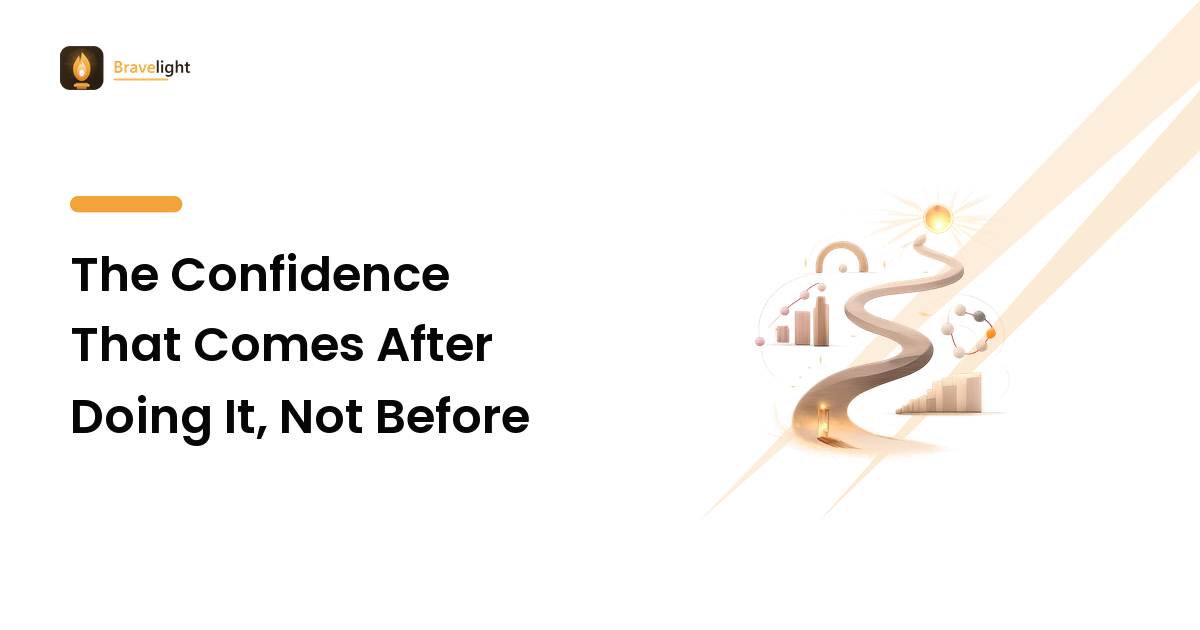
Most people wait to feel confident before they act. That's backwards, and it's the single most useful thing to understand about this whole topic:
- You take a small action slightly beyond what feels comfortable.
- You survive it — often it goes better than predicted, sometimes it's just okay.
- Your brain files the evidence: handled it.
- The next prediction is slightly stronger.
Repeat that loop enough times and the feeling everyone is waiting for shows up on its own. Confidence is a lagging indicator of action. Waiting to feel it first is like waiting to be fit before you exercise.
The rest of this guide is about running that loop deliberately.
Step 1: Shrink the ask until it's genuinely doable
The loop only works if you complete the action, so the first skill is right-sizing the step. Too big, and you avoid it or get overwhelmed — no evidence gets filed. Too small, and there's nothing to learn.
The test: the step should feel uncomfortable but clearly survivable. Some examples of shrinking:
- "Speak up more in meetings" → ask one clarifying question in tomorrow's meeting.
- "Get better at networking" → send one message to one person this week.
- "Learn to say no" → say no to one small, low-stakes request.
If a step still feels too big, that's not a character flaw — it's information. Shrink it again. "Ask one question in the meeting" can become "prepare the question in writing and decide when you'd say it." There is no step too small to count, because the evidence loop runs on completion, not on size.
Step 2: Keep a record your doubt can't argue with
Self-doubt has a convenient memory: it files every stumble in bold and lets the wins quietly fade. So the evidence loop needs a paper trail.
Keep a simple evidence log — a note on your phone is fine. Each time you do something that took a bit of nerve, write one line: what you did, and one sentence about how it went. Not a gratitude journal, not affirmations — a factual record of handled moments.
Two rules make it work:
- Log attempts, not just successes. "Asked for the deadline extension, got a no, survived it" is real evidence — you did the scary thing and the world kept turning.
- Read it before hard moments. Before an interview or a big conversation, three minutes with your own record does more than any pep talk, because it's true and you know it's true.
Step 3: Fix your self-talk without lying to yourself
The problem with classic affirmations ("I am powerful and unstoppable") is that when you don't believe the words, the exercise quietly reinforces the gap between what you say and what you feel.
What tends to work better is realistic self-talk — statements that are both kind and true:
- Instead of "I'm going to nail this," try "I've prepared for this, and I can handle it being imperfect."
- Instead of "I always mess these up," try "Last time was rough; I've done two things differently since."
- Instead of "I'm not the kind of person who speaks up," try "I haven't spoken up much yet."
That last shift — from identity statements to history statements — is the important one. "I'm not confident" sounds like a fact about your nature. "I haven't collected much evidence yet" is a fact about your past, and the past is exactly the thing the evidence loop changes.
Step 4: Practice where the stakes are low
You don't build confidence for job interviews in job interviews — the reps are too rare and too expensive. You build the underlying skills where failure costs nothing:
- Speaking: talk through your ideas out loud alone, then to one trusted person, before any audience.
- Asking: practise small asks — a recommendation from a barista, a question to a stranger at an event — where a "no" is meaningless.
- Disagreeing: voice a mild preference in low-stakes settings ("I'd actually rather try the other place") before you disagree in a meeting.
Low-stakes reps feel almost too trivial to matter. They're not. Your nervous system doesn't grade the venue; it just files another instance of I said the thing and nothing bad happened.
Step 5: Expect the wobble — and don't let it erase the record
Somewhere in this process, something will go badly. You'll speak up and get shot down, or freeze in the moment you'd rehearsed for. This is where most confidence-building quietly dies, so plan for it:
- One bad rep is one data point, not a verdict. Put it in the log next to the wins, factually, without the editorial ("Presentation ran off the rails in the Q&A. Handled it awkwardly. Still stood there and finished.").
- Do a smaller rep soon after. The worst response to a stumble is a long avoidance gap — that gap teaches your brain the situation is dangerous. A quick, easier win re-anchors the loop.
- Separate the outcome from the courage. You control whether you showed up and tried; you don't fully control results. Grade yourself on the part you control.
If a setback knocks you down harder than a wobble — a failure that really costs something — that's a different skill, and we've written a full guide on how to bounce back from setbacks.
A note on imposter syndrome
Imposter feelings — the sense that you've somehow fooled everyone and will be found out — deserve their own mention because they distort the evidence loop itself. Wins get filed under "luck" or "they were being nice," so no matter how much you achieve, the confidence file stays thin.
Two practical counters:
- Attribute wins accurately in your log. When something goes well, write down the specific things you did that contributed — the preparation, the question you asked, the call you made. Luck doesn't prepare slides.
- Notice the double standard. You'd never dismiss a colleague's success as fraud. Practise applying the standard you use for others to yourself.
Imposter feelings are common among capable people moving into new territory — often they're a sign you're growing, not failing. But if feelings of being a fraud are constant, distressing, and don't respond to any of this, talking it through with a mental-health professional is a genuinely good use of your time.
Confidence and fear are neighbours
One last connection worth making: a lot of what looks like low confidence is really unfaced fear. The person who "isn't confident" about public speaking usually means they're afraid of it — and fear has its own toolkit, built around gradual, repeated approach rather than evidence-logging. If that rings true for you, the companion guide on how to face your fears picks up exactly where this one leaves off.
FAQ
How long does it take to build confidence?
Honestly: it depends on the size of the gap and how often you run the loop. Small-situation confidence (speaking up in meetings, making asks) often shifts noticeably within weeks of regular reps. Deeper self-belief builds over months. Anyone promising a fixed timeline — or an overnight transformation — is selling something.
Can you build confidence if you're naturally shy or introverted?
Yes. Introversion is about where your energy comes from, not about capability. Plenty of introverts are quietly, deeply confident. The evidence loop works the same way — you may just prefer smaller-audience reps (one-to-one conversations, written contributions) and that's completely fine.
Is low confidence the same as low self-esteem?
They overlap but aren't identical. Confidence is situational — you can be confident driving and terrified of presenting. Self-esteem is your global sense of worth. Building situational confidence often lifts self-esteem, but if your sense of worth is persistently low regardless of what you achieve, that's worth exploring with a mental-health professional rather than treating as a skills gap.
What if I do the steps and my confidence doesn't improve?
First, check the step size — the most common issue is steps that are still too big, so they get avoided and no evidence accumulates. Second, check your log — if you're doing the reps but dismissing every result, work on the attribution problem in the imposter section. And if self-doubt stays heavy and constant despite genuine effort, it may be tangled with something an article can't reach — reach out to a mental-health professional or local crisis line.
Keep going
Building confidence is a practice, not a personality transplant — and it helps to have a map. You'll find structured frameworks, situation-specific guides, and definitions for the whole journey in the Confidence & Self-Belief guides on Bravelight — practical, honest, and hype-free, one step at a time.