Every fear you avoid quietly redraws the map of your life. Skip the presentation, and meetings get a little smaller. Dodge the hard conversation, and the relationship gets a little shallower. Nobody decides to live inside a shrinking circle — it happens one reasonable-sounding avoidance at a time.
The good news is that the process runs in reverse, too. Fear responds to being approached — gradually, repeatedly, and on your terms. This guide covers how to do that in practice: not by white-knuckling or "feeling the fear and doing it anyway" at maximum intensity, but with a method that works because it's gradual.
Before we start: this article is about everyday fears — speaking up, failing, being judged, starting something new. It's informational self-development material, not therapy. If fear or anxiety dominates your daily life, shows up as panic, or doesn't track to any obvious situation, that deserves real support: reach out to a mental-health professional or local crisis line.
What fear is doing (and why avoidance feeds it)
Fear is your threat-detection system doing its job — noticing potential danger and preparing your body to deal with it. The racing heart, tight chest, and urge to flee before a big moment aren't malfunctions; they're your system taking a social or personal risk seriously.
The trouble starts with what happens next. When you avoid the feared thing, you get an immediate reward: relief. And your brain files the wrong lesson — not "that thing was safe after all," but "avoiding that thing kept me safe." The fear gets confirmed, the relief gets addictive, and next time the pull to avoid is stronger.
This is the avoidance loop, and it's the single most important thing to understand about fear:
- Feared situation appears.
- Anxiety rises.
- You avoid or escape.
- Anxiety drops fast — huge relief.
- The brain learns: avoidance works. Fear grows.
The way out is equally well-established, and it's the foundation of how clinicians and coaches have helped people face fears for decades: gradual, repeated, voluntary approach. When you stay in a feared situation long enough for your system to discover it's survivable — and repeat that discovery — the fear response genuinely fades. Not because you talked yourself out of it, but because your brain updated its file with better data.
First, a line worth drawing
Facing your fears is powerful advice for everyday fear. It is bad advice for some situations, and pretending otherwise would be dishonest:
- If fear comes with panic attacks, or is so intense you can't function around it, gradual self-guided practice may be too blunt an instrument. A mental-health professional can build a proper plan with you — that's not weakness, it's using the right tool.
- If the fear is warning you about something genuinely unsafe — a dangerous person, an abusive situation — the answer is not exposure. The answer is getting out and getting support.
- If "fear" is actually persistent dread that attaches to everything, that's a different animal from situational fear, and worth discussing with a professional.
Everything below assumes everyday fear: uncomfortable, limiting, but safe to approach.
Step 1: Name the fear precisely
"I'm afraid of public speaking" is too vague to work with. Afraid of what, exactly? Forgetting your words? Being visibly nervous? A hostile question? Being judged as not smart enough?
Take the fear and interrogate it on paper:
- What is the actual feared event? Get to the specific image your mind flinches away from.
- What do I predict will happen? Write the prediction out in full. ("I'll go blank, everyone will notice, and they'll conclude I'm not up to the job.")
- How bad would that actually be, and what would I do next? Not to minimise — to make the aftermath concrete. Fears live on vagueness; specific plans starve them.
Often this step alone shrinks a fear noticeably, because the written version is more survivable than the fog it replaced. What's left is a specific, testable prediction — which is exactly what the next step is for.
Step 2: Build an exposure ladder
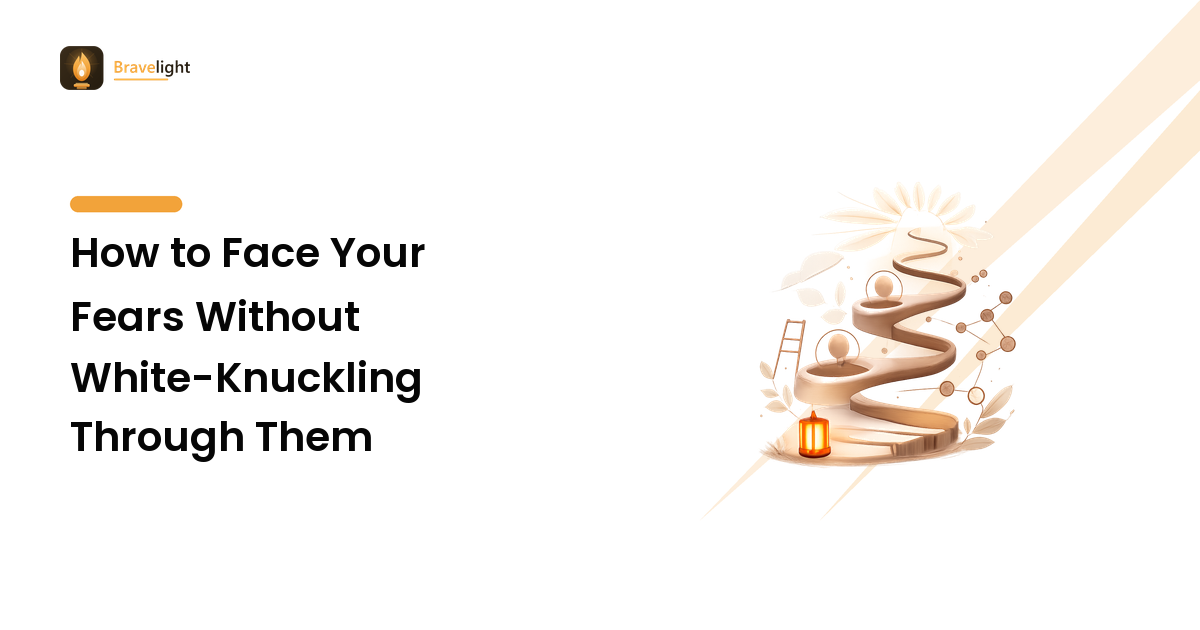
An exposure ladder is a list of versions of your fear, ordered from mildly uncomfortable to genuinely hard. Instead of leaping at the top rung (the classic white-knuckle mistake), you start at the bottom and climb.
Say the fear is speaking up in meetings:
- Write out a comment you would have made, after the meeting. (Barely uncomfortable.)
- Ask one prepared, factual question in a small meeting.
- Offer one opinion in a small meeting.
- Ask a question in a larger meeting.
- Disagree — politely, once — with a point in a small meeting.
- Present a short update to the larger group.
Rules that make ladders work:
- Each rung should be uncomfortable but doable — roughly a 4–6 out of 10 on your own dread scale, not a 9.
- Stay on a rung until it loses its teeth. One rep rarely does it. Repeat until the step feels merely mildly annoying, then climb.
- Voluntary beats ambushed. You choose the rung, the day, the setting. Control is part of why this works.
- A "failed" rep still counts. You asked your question and stumbled over it? You still taught your system that stumbling is survivable — which is half the fear right there.
If a rung is too hard, don't abandon the ladder — split the rung. Between "ask a question" and "offer an opinion" there might be "agree out loud with someone else's point and add one sentence." There is always a smaller step.
Step 3: Steady the body so the mind can work
Fear is physical before it's mental — the pounding heart shows up before the catastrophic thoughts finish forming. So it helps enormously to have one or two body-steadying techniques practised in advance, not invented mid-crisis:
- Slow, extended exhales. Breathe in for a count of four, out for a count of six to eight. A handful of slow breaths with long exhales signals your nervous system that you are not, in fact, being chased. Do this in the minutes before a rung, and quietly during if needed.
- The 5-4-3-2-1 grounding check. Name five things you can see, four you can hear, three you can touch, two you can smell, one you can taste. It sounds almost silly, and it works — it pulls attention out of the fear-spiral and into the present, where things are usually fine.
- Feet and hands. Press your feet into the floor; notice the pressure. Loosen your grip on the pen. Small physical anchors, big steadying effect.
To be clear about what these do: they don't delete fear, and they're not meant to. They keep arousal at a level where you can stay in the situation — which is where the real learning happens.
Step 4: Reframe what fear means — honestly
Some reframes are lies with good marketing, and your brain knows it. "There's nothing to be afraid of!" doesn't survive contact with a real audience. Honest reframes work better because they don't ask you to deny your own experience:
- Fear means it matters. You don't get a racing heart over things you don't care about. Nerves before the interview are evidence of stakes, not evidence of inadequacy.
- Courage requires fear. Doing something you're not afraid of doesn't take courage. Every rep on your ladder is courage, by definition — including the wobbly ones.
- Excitement and fear share hardware. The physical signature of nervousness and anticipation is nearly identical; sometimes "I'm ready and keyed-up" is as accurate a label as "I'm scared," and the label you choose shapes what happens next.
- The prediction has failed before. By rung three of your ladder, you have receipts: your fear predicted disaster and disaster didn't come. Reference your own data.
Step 5: Repeat, expect the dip, and keep the circle wide
Two truths about the long game:
Progress isn't linear. You'll have a week where rung four feels easy, then a bad day where rung two suddenly bites again. This is normal and doesn't mean the method failed — courage, like fitness, fluctuates around a rising trend. Log your reps somewhere (the same evidence log we recommend in our guide on how to build confidence works perfectly), so a bad day can't gaslight you about the trend.
Faced fears regrow if you stop approaching. Not to their original size, usually, and not quickly — but a comfort circle maintains its width through use. The sustainable version isn't a heroic season of ladder-climbing followed by retreat; it's a habit of regularly doing small things that are slightly outside comfortable. One mildly brave act a week keeps the machinery warm.
And when a rep goes genuinely wrong — you took the risk and it cost you something real — that's no longer a fear problem but a recovery problem, and it has its own playbook: see our guide on how to bounce back from setbacks.
FAQ
Is it better to face a fear all at once or gradually?
Gradually, for almost everyone. The "throw yourself in the deep end" approach occasionally works, but it fails badly when it fails — an overwhelming experience can confirm the fear instead of correcting it. Ladders are slower and far more reliable, and reliability is what you want from a method you'll use on yourself.
What if I face my fear and the bad thing actually happens?
Then you've learned two things: the bad outcome is survivable (you're still here, reading), and you can now plan for it concretely instead of dreading it vaguely. Handle the recovery honestly — feel it, sort out what was bad luck versus bad process, adjust the ladder — and go again at a lower rung. One bad outcome is a data point, not a verdict.
How do I face a fear of failure specifically?
Fear of failure is really fear of what failure means — judgment, wasted effort, confirmation of doubts. So the ladder is built from small, contained failures: share work at 80% polish, enter something you might lose, ask for something you might not get. Each survivable "no" or imperfect result teaches your system that failure is an event, not an identity.
When is fear a sign I should stop rather than push on?
Stop when the fear is pointing at genuine danger (physical, financial, or a situation that's actually unsafe), when it comes with panic attacks or dread that pervades daily life, or when "facing it" is something someone else is pressuring you into. Gradual self-guided practice is for everyday fear that you choose to approach. For anything heavier, reach out to a mental-health professional or local crisis line — getting help is facing it.
Keep going
Facing fear gets easier with a map in your hands. You'll find step-by-step methods — fear-setting, exposure ladders, grounding routines, and more — in the practical frameworks for facing fear on Bravelight, written the same way this guide is: honest, gradual, and hype-free.