You've decided to make your lighting smart, and hit the fork every buyer hits: screw in smart bulbs, or replace the wall switch? They sound interchangeable in the store. They aren't — pick the wrong one and you get a light you can only turn on by phone, or a fixture that can never show the warm-to-cool color you bought it for.
The takeaway up front: smart bulbs put the intelligence in each bulb, so they win on color and per-bulb scenes and need no wiring — but they go dead the moment someone flips the wall switch off. Smart switches put the intelligence in the wall, so they control a whole fixture, keep the switch working for everyone, and suit sealed LED fixtures — but they can't do color and often need a neutral wire. The right choice is decided fixture by fixture, not once for the whole house.
The core difference: where the "smart" actually lives
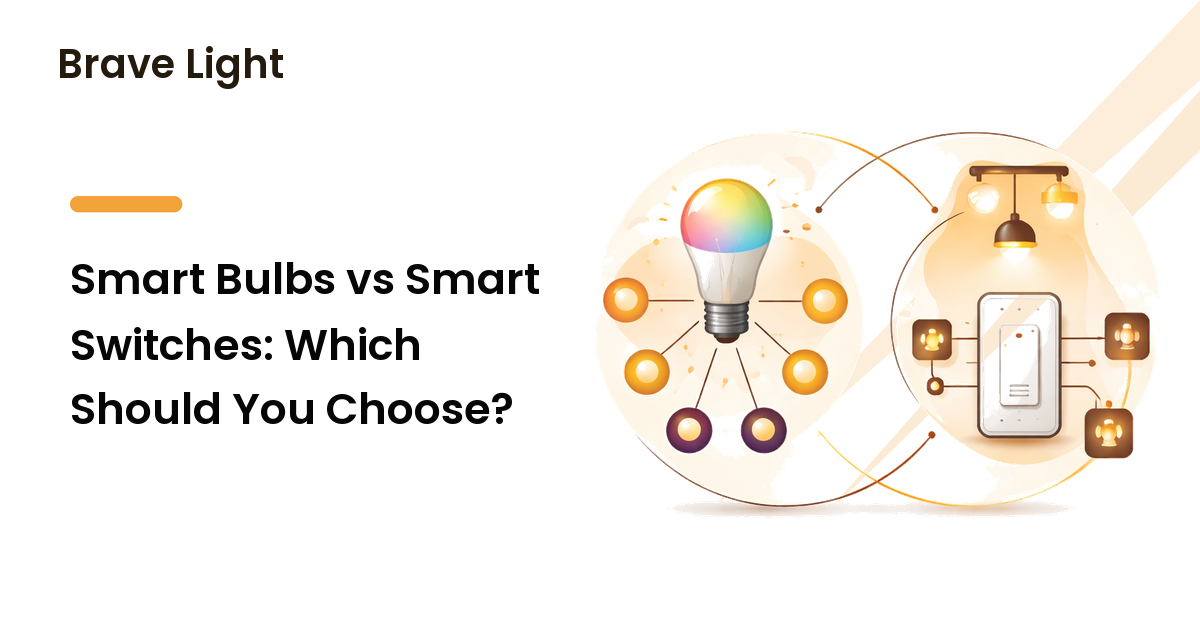
A smart bulb is a normal-shaped bulb with a tiny computer and radio inside. It screws into an ordinary socket and talks to your phone or a hub over Wi-Fi, Bluetooth, Zigbee, or Thread. Because the smarts sit inside the bulb, it controls exactly one bulb — its own brightness, and usually its own color.
A smart switch (or smart dimmer) replaces the switch on the wall. The bulbs downstream stay ordinary "dumb" bulbs; the switch decides whether they get power and, if it dims, how much. Because the smarts sit at the wall, one switch controls the whole fixture — one bulb or twelve.
That single distinction drives every trade-off below. A smart bulb controls a bulb; a smart switch controls a fixture.
When smart bulbs are the right choice
Reach for smart bulbs when what you're controlling is small or colorful:
- You want color or tunable white. Only the bulb changes its own color — full RGB and warm-to-cool white live there, never in a plain switch.
- You rent, or won't touch wiring. They screw in with zero electrical work and unscrew to move with you when you go.
- The fixture holds one or two bulbs. A bedside lamp or single pendant needs just one smart bulb, so cost stays low and color comes free.
- You want different bulbs doing different things in one room. Each bulb is independent, so a reading lamp can run bright and cool while an accent lamp glows warm — a scene one switch can't produce.
- The lamp isn't on any wall switch. A plug-in lamp with only a cord switch can be made smart only by a smart bulb (or a smart plug).
When smart switches are the right choice
Reach for smart switches when you're controlling a whole fixture and color doesn't matter:
- The fixture has many bulbs. A six-bulb chandelier or eight recessed cans means one switch instead of six or eight smart bulbs — cheaper, and one control instead of many that must stay in sync.
- You want the wall switch to keep working for everyone. Guests, kids, cleaners, and your own muscle memory all reach for the wall. A smart switch still works as a normal switch and adds app and voice control, so nothing gets "stuck off." This is the big one.
- The fixture has no replaceable bulb. Sealed integrated LEDs — flat panels, many downlights, some vanity bars — have no bulb to swap, so a smart dimmer at the wall is the only way to make them smart.
- You want simple whole-room on/off and dimming from the wall, with cheap dumb bulbs you never think about again.
Smart bulbs vs smart switches at a glance
| Factor | Smart bulbs | Smart switches |
|---|---|---|
| Color / tunable white | Yes — lives in the bulb | No — only what the dumb bulb offers |
| What it controls | One bulb each | The whole fixture / circuit |
| Wall switch still works | Only if it always keeps power | Yes, works normally |
| Install | Screw in, no wiring | Replace the switch (neutral often needed) |
| Cost per fixture | Scales with bulb count | Flat, one switch |
| Sealed / integrated LED fixtures | Won't fit | Works |
| Renter-friendly | Yes, take them with you | Usually not (wiring) |
| Bulb replacement | Buy another smart bulb | Any cheap dumb bulb |
The dealbreakers nobody mentions before you buy
Each approach has one classic regret. Know both before you spend:
- The off-switch problem (smart bulbs). A smart bulb only works while it has power. Flip the wall switch off and it's dead — no app, schedule, or voice — until someone flips it back. In a home that uses the wall out of habit, this is the number-one smart-bulb regret. Fixes: keep the switch on and use app, voice, or a small button; add a switch guard; or fit a switch that signals the bulb instead of cutting its power.
- The neutral-wire requirement (smart switches). Many smart switches need a neutral wire at the box, and older homes often lack one at the switch. No-neutral models exist but trickle power through the bulbs, which can leave low-wattage LEDs faintly glowing or flickering when "off" — the same quirk behind many LED flickering complaints. Check the box before you buy.
- Dumb bulbs behind a dimmer must be dimmable. A smart dimmer needs dimmable LEDs downstream, or they buzz and flicker; if you only need on/off, a smart relay switch avoids this.
- Never put a smart bulb behind a dimmer. A smart bulb wants clean, constant power to do its own dimming; a wall dimmer's chopped waveform makes it flicker or drop offline.
- Multi-switch spots need matching kit. A light controlled from two ends (a 3-way) needs a smart switch made for it, usually with a companion add-on switch.
Cost: count the bulbs in the fixture
The cheapest decision follows one rule — count the bulbs in the fixture. One or two bulbs (a lamp, a single pendant): a smart bulb is cheapest, and color comes free. Several bulbs (a chandelier, a bank of cans): one smart switch beats a smart bulb in every socket and controls them as one. No removable bulb (a sealed LED panel or downlight): nothing accepts a smart bulb, so a switch is the only option. Buying a smart bulb for every socket in a big fixture is how people overspend on smart lighting.
The hybrid setup most homes actually want
You don't have to pick one philosophy for the whole house — and the best setups don't:
- Smart switches on big overhead and multi-bulb fixtures and every sealed LED, so whole-room control stays at the wall for anyone.
- Smart bulbs in lamps and accent spots where color and per-bulb scenes actually matter.
The one rule when mixing them: don't stack a smart bulb behind a smart dimmer — the dimmer chops the power the bulb needs. Where a fixture runs smart bulbs, give it a switch that always sends full power. Pick one system (Matter and Thread make cross-brand setups far less fussy) so bulbs and switches share one app and one set of scenes.
FAQ
Are smart bulbs or smart switches better?
Neither overall — they solve different problems. Bulbs win for color, per-bulb scenes, renters, and one- or two-bulb fixtures. Switches win for many-bulb fixtures, sealed LEDs, and keeping the wall switch working for everyone. Decide fixture by fixture, not once for the house.
Can I use a smart bulb with a smart switch or dimmer?
Not behind a dimmer — a smart bulb dims itself and needs steady, full power, so a dimmer's chopped power makes it flicker or drop offline. A plain switch that only cuts power works, but it's better to leave the bulb powered and control it by app, voice, or button.
Do smart switches need a neutral wire?
Most do — the electronics need a neutral to stay powered while the light is off, and many older homes lack one at the switch box. No-neutral models exist but can make low-wattage LEDs glow or flicker faintly. Check your box before buying.
What happens to a smart bulb when the wall switch is off?
It goes completely offline — no app, schedule, or voice — until the switch is flipped back on. This "off-switch problem" is the most common smart-bulb regret. Keep the switch on and control the bulb another way, or fit a switch that signals the bulb instead of cutting power.
Are smart bulbs worth it for renters?
Usually yes. They screw into existing sockets with no wiring, need no landlord approval, and move with you when you go. For renters who want color and app control without touching the wall, bulbs are the obvious pick.
Choose by the fixture, not the hype
Smart lighting stops being confusing the moment you ask one question per fixture: am I controlling a bulb, or a whole fixture? Color, a single lamp, or a rental points to a smart bulb; a many-bulb fixture, a sealed LED, or a switch everyone must flip points to a smart switch. Mix the two on purpose and you get color where it counts and reliable wall control everywhere else. For more practical, vendor-neutral lighting guidance, explore Brave Light at bravelight.net.