You're standing in the bulb aisle, or scrolling a product page, and every box promises the same brightness — but one says "soft white," another "bright white," and a third just says "daylight." Pick wrong and your cozy living room turns clinical, or your bathroom mirror makes you look faintly unwell. Brightness was never the problem. The color of the light was.
Here's the takeaway up front: color temperature, measured in kelvin (K), is the color of a bulb's white light — from warm amber at the low end to cool blue-white at the high end. Lower numbers like 2700K feel cozy and relaxing; higher numbers like 4000K and up feel crisp and alerting. There's no single "best" bulb — the right choice is matching the kelvin to what the room is actually for. Get that match right and every room reads the way you want, with no returns.
What color temperature actually means
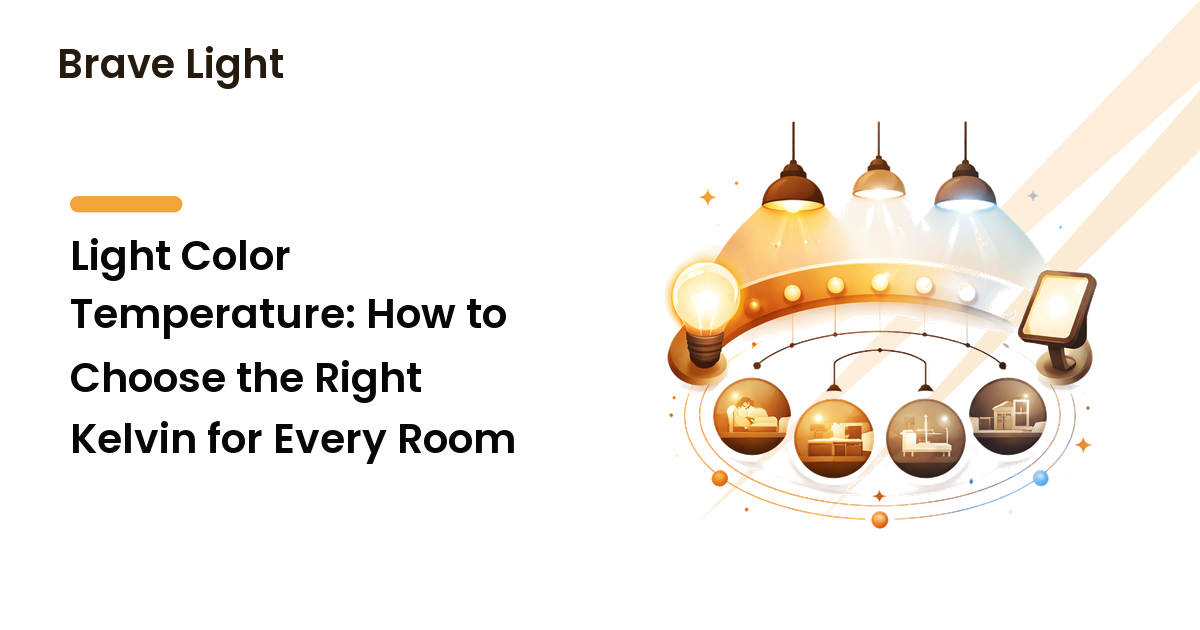
Color temperature describes the hue of white light on a scale called kelvin. It's a genuine physical measurement, not a marketing label: it comes from the color a theoretical object glows as it heats up, passing from dull red-orange through yellow-white to blue-white. That's why a candle flame sits low on the scale and a bright midday sky sits high.
One quirk trips up almost everyone. On the kelvin scale, lower numbers are "warmer" (more orange) and higher numbers are "cooler" (more blue) — the opposite of how we label hot and cold taps. "Warm" and "cool" here describe how the light feels, not its physics. Anchor on that and the numbers stop being confusing: 2700K is the warm glow of a traditional incandescent bulb, and 6500K is the blue-white of an overcast noon.
The color temperature scale, from candlelight to daylight
Most household bulbs live between 2700K and 6500K. Here's how the range breaks down and where each band earns its place:
| Kelvin | Looks like | Feels | Best for |
|---|---|---|---|
| 2200–2400K | Candle, deep amber | Intimate, mellow | Mood and decorative lighting, dimmed evenings |
| 2700K | Traditional incandescent | Cozy, restful | Living rooms, bedrooms, lounges |
| 3000K | Warm white, soft halogen | Warm but cleaner | Living areas, dining, warmer kitchens and baths |
| 3500K | Neutral-warm | Balanced, easy | Transitional spaces, some offices |
| 4000K | Neutral, "bright white" | Crisp, awake | Kitchens, bathrooms, offices, laundry, garages |
| 5000K | "Daylight" | Energizing, stark | Workshops, detailed tasks, grooming mirrors |
| 6500K | Cool daylight, noon sky | Clinical, very alert | Garages, inspection, plant growth |
You don't need to memorize the table — just its shape: light gets cozier as the number drops and more clinical as it climbs.
Warm white vs cool white vs daylight: decoding the box
The kelvin number is precise. The words on the box are not. Manufacturers use friendly names that drift from brand to brand, so learn the rough translation and then trust the number:
- Soft white / warm white ≈ 2700–3000K. The cozy, slightly golden light most people picture as "normal" home lighting.
- Bright white / cool white ≈ 3500–4100K. A cleaner, more neutral light — awake, but not blue.
- Daylight ≈ 5000–6500K. The coolest, bluest-white option; crisp and energizing, and the one people most often regret buying for a living space.
Two boxes can share a name and still sit a few hundred kelvin apart, so when it matters, ignore the name and buy by the kelvin number printed beside it. "Daylight" is the biggest trap: it sounds natural and healthy, but at 6500K it makes a lounge feel like a waiting room.
The best color temperature for each room
Match the kelvin to the room's job: relaxation wants warm light, tasks and grooming want neutral-to-cool. Here's a room-by-room starting point, each with the reason behind it:
- Living room — 2700K. This is where you relax and entertain, so warm light that flatters skin and furniture and quietly signals "wind down" beats a crisp white that keeps everyone alert.
- Bedroom — 2700K, or lower. The room's whole job is rest, and warm, dim light in the evening feels calmer to most people than bright white. Add a cooler task lamp only if you read in bed.
- Kitchen — 3000K to 4000K. A working room that also has to look inviting. 3000K keeps an open-plan kitchen friendly next to the living area; a closed, hard-working kitchen benefits from 4000K so you can actually see what you're chopping.
- Bathroom — 3000K to 4000K. Grooming needs honest, even light. 3000K feels spa-like; 4000K around the mirror renders skin and makeup accurately without the harsh blue cast of true daylight.
- Home office — 3500K to 4500K. Neutral-to-cool light helps you stay alert and read detail, so focus doesn't sag by late afternoon; just keep the source out of your eyeline to avoid screen glare.
- Dining room — 2700K. Food and faces look their best under warm light, and dinner is for relaxing — lean warm, and put it on a dimmer.
- Hallways, stairs, closets — 2700K to 4000K. Match the rooms they open onto so the transition doesn't jar; closets can go cooler (4000K) to show true clothing colors.
- Garage, laundry, workshop — 4000K to 5000K. Function over mood: cool, bright, neutral light reveals detail and keeps you alert for the task at hand.
If you remember one rule, make it this: warm light (2700–3000K) where you relax, neutral-to-cool light (4000K and up) where you work.
Keep a room's lights consistent
The fastest way to make good bulbs look bad is to mix color temperatures within one sightline. A 2700K lamp beside a 5000K ceiling light reads as "one of these is broken," because your eye judges white by comparison rather than in isolation. So:
- Buy all the bulbs for one room at the same kelvin, in one go, so batches match and nothing looks off.
- Where two spaces are visible at once — an open-plan kitchen and living room — keep them within a step of each other (say 2700K and 3000K), never 2700K against 5000K.
- Want flexibility? Tunable-white bulbs shift from warm to cool on demand, so one fixture can glow 2700K at night and switch to 4000K for a task — worth the extra cost in kitchens, offices, and bedrooms that double as workspaces.
Color temperature is only half the story
Kelvin sets the color of the light. Two more numbers decide whether the room actually looks good under it:
- CRI (Color Rendering Index) is how truthfully colors appear. A low-CRI 3000K bulb can still make food and skin look flat and gray, so aim high — especially in kitchens, bathrooms, and closets where accurate color matters most.
- Lumens is the amount of light. Kelvin won't rescue a room that's simply too dim or blindingly bright; that's a separate decision.
Color temperature is just one line on the bulb's spec panel. For how to read the rest — lumens, CRI, and dimming compatibility — see our guide to choosing light bulbs by the label. Match all three to the room and the bulb will do its job.
Common color temperature mistakes to avoid
- Buying "daylight" (6500K) for living rooms and bedrooms because it sounds natural — it feels like an office instead.
- Mixing warm and cool bulbs in the same room or open sightline, which reads as a fault rather than a choice.
- Choosing kelvin by brightness. A warm bulb can be very bright and a cool bulb can be dim; color and output are independent numbers.
- Forgetting the dimmer. Warm light at full blast still isn't restful — pair warm bulbs with a dimmer wherever you unwind.
FAQ
What is the best color temperature for home lighting?
There's no single best — it depends on the room's job. Warm light around 2700–3000K suits living rooms, bedrooms, and dining rooms where you relax, while neutral-to-cool light around 4000K suits kitchens, bathrooms, offices, and garages where you work. Match the kelvin to the activity and every room reads right.
Is warm white or cool white better?
Neither is better overall — they're built for different jobs. Warm white (2700–3000K) feels cozy and relaxing, so it belongs where you wind down. Cool white (4000K and up) feels crisp and alerting, so it belongs where you need to see detail and stay awake. Most homes want warm in living spaces and cool in work spaces.
What does kelvin (K) mean on a light bulb?
Kelvin is the unit for color temperature — the color of the bulb's white light. Lower numbers like 2700K are warm and amber; higher numbers like 5000–6500K are cool and blue-white. It's separate from brightness: a 2700K and a 5000K bulb can be equally bright yet look completely different.
What's the difference between soft white and daylight bulbs?
Soft white is roughly 2700–3000K — the warm, slightly golden light of a traditional home bulb. Daylight is roughly 5000–6500K — a cool, blue-white light that feels crisp and clinical. Soft white suits living areas and bedrooms; daylight suits garages, workshops, and detailed tasks and usually feels too cold in a lounge.
Is 4000K too cold for a bedroom?
For most people, yes, in the evening — 4000K reads as crisp and awake, which works against winding down. Bedrooms are usually most comfortable at 2700K, ideally dimmable. If you also read or work in the room, add a separate task lamp, or a tunable-white bulb you can switch to cooler light only when you need it.
Should every light in a room be the same color temperature?
As a rule, yes. Your eye judges white by comparison, so a warm bulb next to a cool one looks broken. Keep one room — and each open-plan zone — on a single color temperature, and keep visually connected rooms within a step of each other rather than mixing 2700K with 5000K.
Choose the color, not just the brightness
Color temperature is the quietest big decision in lighting: it doesn't change how much light you get, but it changes how a room feels — cozy or clinical, restful or alert. Learn the scale, buy by the kelvin number instead of the name on the box, match it to what each room is for, and keep every room consistent. Do that and you'll stop returning bulbs and start walking into rooms that feel exactly right.
Brave Light is a vendor-neutral resource that recommends by technique and fixture type — with the reason always spelled out — never by brand. For more room-by-room lighting guidance you can actually put to use, explore bravelight.net.